

Tech Ed 4 Kids Partners with Parents, Students, and Teachers to Measurably Propel Student Achievement in Science, Technology, Engineering and Math

Common Core?
It seems like almost everyday I hear a complaint about common core. Maybe I’m just more sensitive and notice it more at the moment, but the complaints are definitely there. All the complaints seem aimed at math specifically.
The reason given for common core is to make things easier for high schoolers by developing number sense early. The main reason I’ve always tried to tell students is that it’s giving you a lot more ways to solve problems and it’s taking steps that you normally would take and putting them in step by step directions. Another author I was reading mentioned that new moms are given information early on the importance of literacy, but math and numbers? I remember with my first asking him how many crackers he wanted at 18 months old as he would ask for a snack. Then I would count them out. If he wanted more he told me how many. He quickly developed a basic concept of counting from 1 to 20. We used math in other parts of our life, but that was something easy that I started with.
Many people use some of the basics of common core while doing basic math, they just don’t use the words common core to describe it. Common Core really just means it’s a common standard so that everyone is learning the same things at the same time. So if you move from one area to another you should have received the same base and be ready to go from where you are. When you think of adding 12 + 18 ; we can make that 12 into 10 and 2 and we make the 18 into 10 and 8, We really get (10 + 10 + 8+2 ) For some people that’s easier. I had never really noticed it in quite so bright of focus until my husband mentioned distributive process. As I realized I’ve been doing this all along, it became easier to start to make sense of other parts of the standards. The standards do start by focusing on tens, because most people are more comfortable with tens, count by 10 vs count by 7 which can you do quicker.
To multiply two big numbers you have some choices. 23 * 34 becomes either a square with 20 and 3 down the side and 30 and 4 across the top. Then fill in the 4 squares with the multiples. 20*30, 20*4, 3*30,3*4 and finally add all those numbers together 600+80+90+12 and it adds up to 782. After I did it this way the first time and realized how easy it was I wondered why I ever did it another way.
Of course I can also use distributive. That really just means rewrite one of the numbers, like 34 to 30 and 4, then rewrite the equation: 23(30*4)…. So that I get 23*30 + 23*4 = 690+92=782.
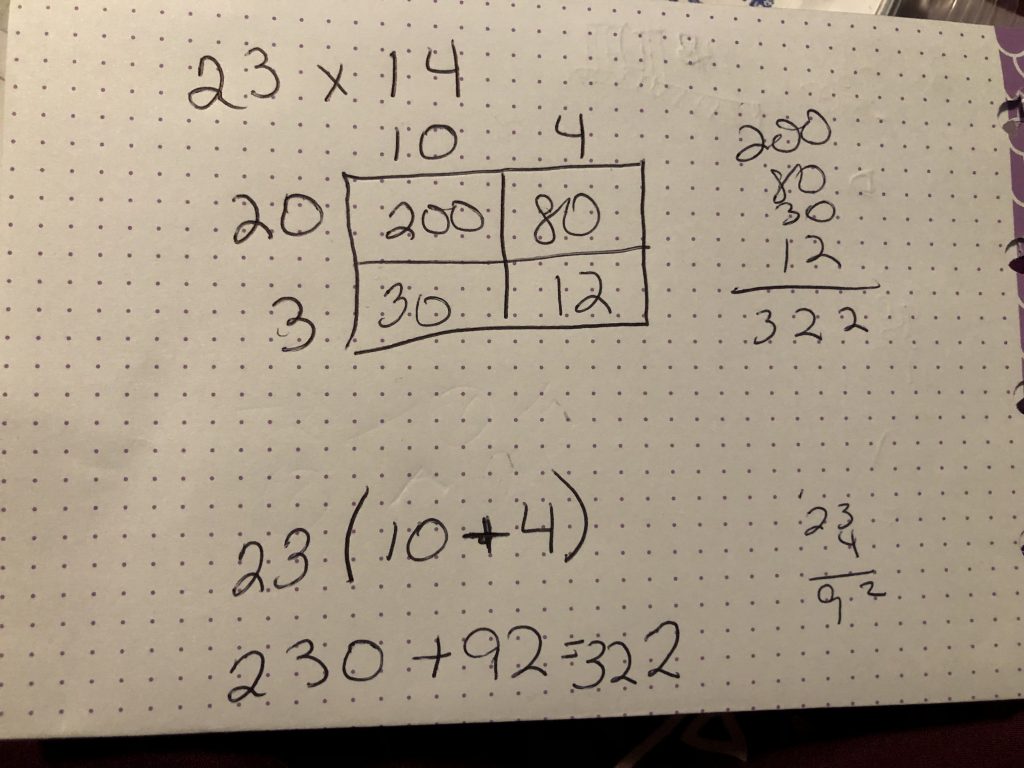
There is a lot of trying to get students to estimate in common core; which I admit isn’t my favorite and I can see where it’s being taught in a confusing way. Instead of showing a jar of marbles with estimate how many marbles, questions have estimate the number 842. Well of course a literal child is going to estimate 842 as 842. They know the number already. If you told me how many marbles in the jar, I’d estimate it correctly too.
My son also lost points for giving the correct answer when asked to estimate. I do have a hard time with losing points on homework for a correct answer simply because the question said estimate. If given the numbers for the calculation it’s hard for some to not come up with the actual answer for a child that loves everything to be literal.
Graphing and Calculators
Flashing back on Friday I’m reminded that we didn’t have calculators in school or home when I was in school (similar to the we walked two miles uphill both ways to get to school)! When calculators did make it to school they were nothing more than simple adding machines. Now students have access to not only adding machine type calculators on their phones but also graphing calculators (check out the Desmos web site), and phone apps like Photomath.
We all know that 2+2 can be pretty tough, just look at the math equation that made the rounds the other day on Twitter that stumped a lot of people. Just so you know I think it should be written PE(M/D)(A/S)…. Arguing I think is still going on about whether it’s 16 or 1 (definitely 16) though it would have been better if the problem had included more parenthesis. Personally though I try to avoid adding a long list of numbers in my head (calculator to the rescue).
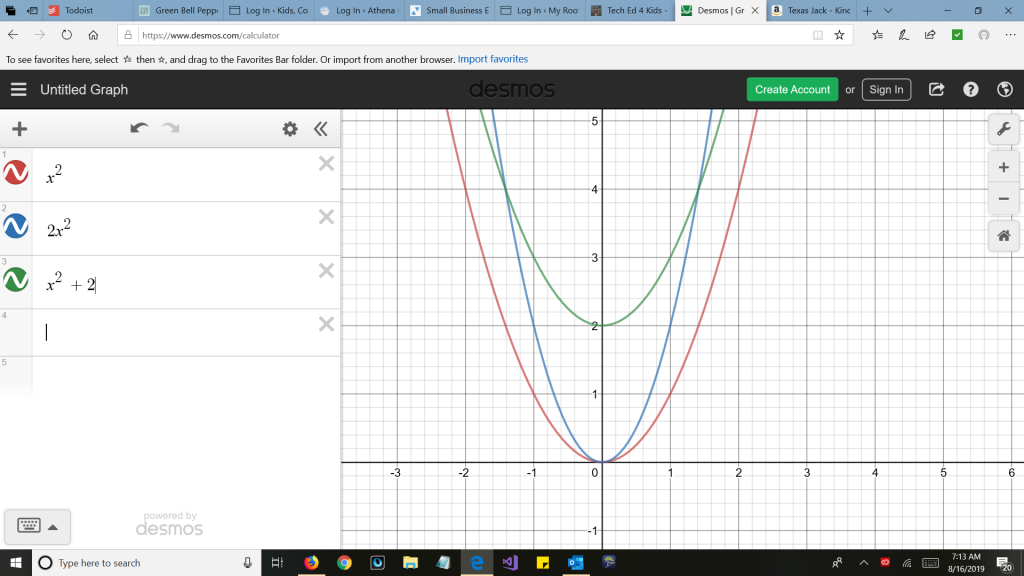
Graphing calculators become required by the time you reach Algebra II – some students don’t get there and that’s ok… but I think it’s fun and definitely explains everything little clearer if you can see it on a graph. For that use Desmos.com to graph your equations -even on the same graph paper and compare the equations. Sometimes it’s good to even just see if that slope is correct.
On the graph below I have three different lines graphed. I can turn off one at a time and see what effect any changes have to the graph of my original line.
The final tool though is Photomath. I have to say that this one I think can be used for good or evil and I’ll review it more later. It’s an app that can be used to help find a solution and get you on the right track when you are totally stumped or to cheat on homework and solve all the problems. The makers of the app also built in a feature to show the steps when it solves your homework problem for you, so for students that have to show their work, expanding and copying works great until they have to complete the same program on a test in class with no phone. Yikes.
The really cool thing with these are that if kids love math, they can now have all sorts of amazing fun tools that they can use to their advantage. I think my kids spent one whole afternoon asking Alexa math problems that included infinity for fun. (Try infinity divided by 0 and see if you get the right answer? We weren’t the other day) ;0)
iRobot (Robots Too)
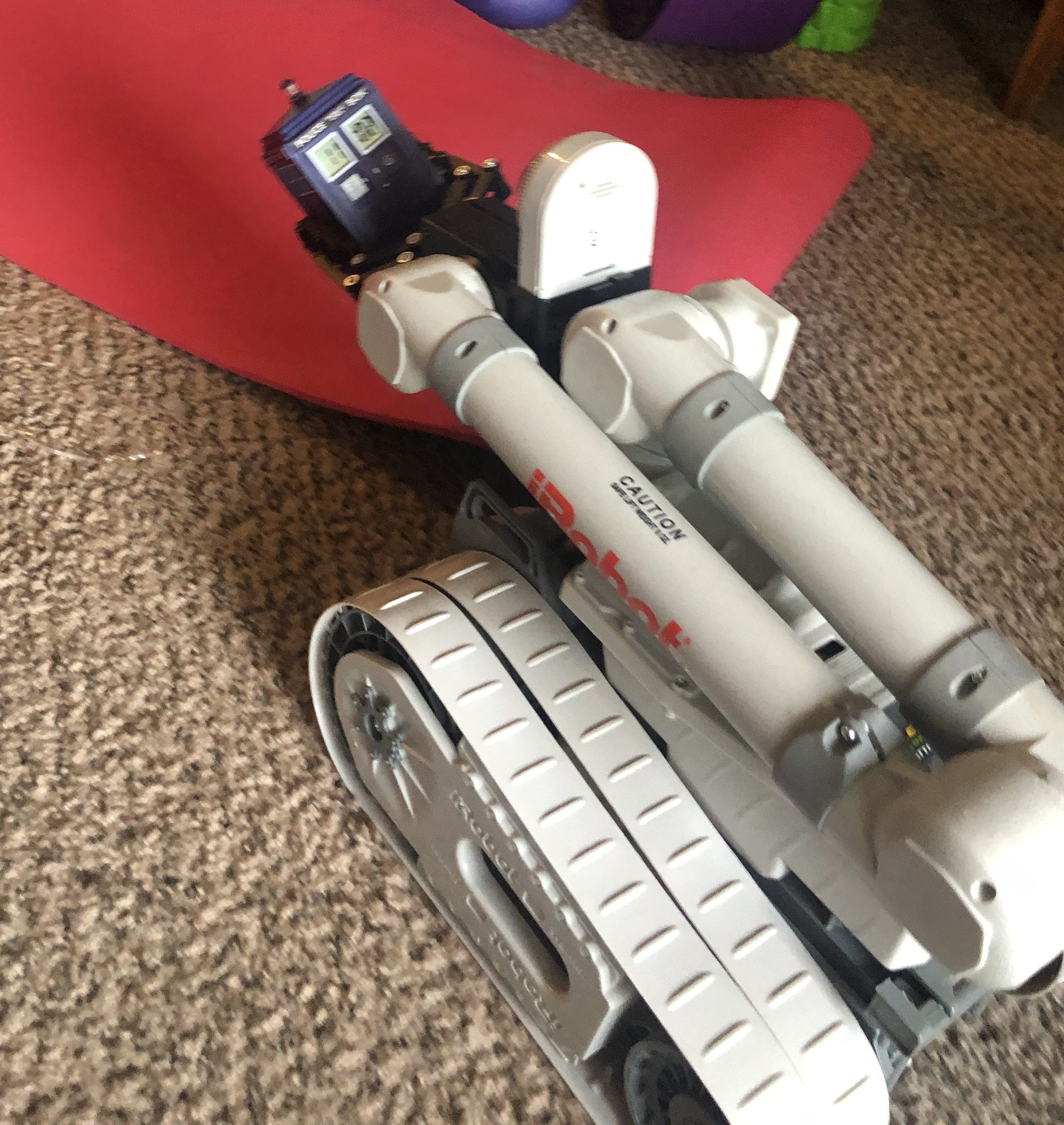
This year we decided to add an iRobot remote controlled robot to our collection. It has a rechargeable battery, a camera, and treads! The cool arm that is included has a pincher that allows the robot to pick up items and carry them around the house.
The boys on the day the picture was taken drove the robot around with a miniture TARDIS in it’s pincher arm and let it explore the kitchen. We haven’t though managed to get the camera to work correctly and hooking it to the phone isn’t a simple task. Using it with the remote is simple, and we have been sticking with that method so far.
I plan to take it outdoors soon as and see how it handles on the grass and driveway. For indoors it’s done a great job. I’m just waiting for my mother to borrow it to use to pick fetch things in her house so that she won’t have to get up from her chair.
Tech Break? How about tech time?
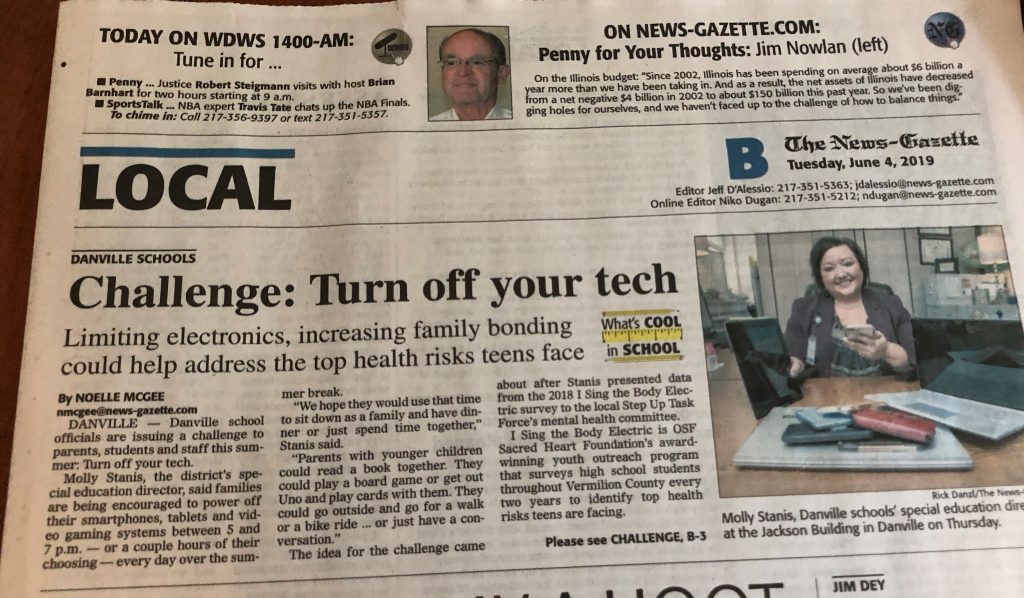
Our paper just ran an article that included a challenge to take a tech break each day – which is great, but I’d like to challenge everyone to take an hour using tech each day and learn something.
There are so many great sites available online for everyone from kids to adults to learn something online. For my school we have been using Outschool a lot lately. It lets him take a live class online using conferencing software. I also like Kahn academy. My son has been playing Prodigy a lot also and really enjoys it. Prodigy is free to teachers and students and only costs for extra features.
My favorite is also Craftsy (changed it’s name to mybluprint.com), lots of classes on cooking, baking, and crafts! YouTube also has tutorials on almost everything you could imagine. There are videos available throughout the web with tutorials for learners of all types.
Some groups, for example the Holderness Family, have started making videos showing them trying DIY activities from other tutorial videos showing how doable the activities really are. Right now though I’m looking through classes relating Star Wars to Reading and Writing, Taking things apart safely (engineering), and even building emotional intelligence. Fitness classes, STEM classes, art classes all are now available using tools such as Zoom allowing them to be interactive. Students giving presentations, asking questions, all in real time and saved for later to be viewed again for review or when a student misses a class.
Most parents and every teacher has heard of the summer slide, where students lose ground over the summer and have to spend the first quarter of the new year reviewing what they learned the year before to get back to where they were at the end of the previous school year. By staying active, and using some time each day, online tutorials can be used keep kids moving forward, and by choosing fun interactive topics, the kids can develop a love for learning. Check out Mentos in Coke! Summer is also a great time to make a volcano outside, make a rocket, do some learning with drones, explore water currents in a stream, learn some bug science, there are so many cool things that can be tied to the outdoors during the summer.
Learning doesn’t have to stop with kids! Modeling learning for life by checking out some classes yourself is a great way to teach kids to never stop learning. Ever wanted to learn painting, vinyl, baking, a language, the topics are endless! And there is no reason not to play outside too!

Prodigy
My son likes doing math and his school has used prodigy for several years. A couple different schools through the last couple years, but they both have used prodigy. The school has provided the basics for him, but we finally went ahead and got him the parent upgrade that includes some additional content.
Prodigy is free to schools and students – completely funded by the extras parents can add. So far my son is still loving it. He’s about maxed out the grade level content available to him – It includes K-8, so I’m looking at getting him excited about Kahn academy after he has completed everything there is to do in Prodigy. Most kids that play with Prodigy won’t reach that max until they are close to the end of 8th grade.
I can highly recommend Prodigy though. My son finds it challenging and interesting as well as having a fun component!

Ted Talk on Procrastination
My middle son just started a special research program at Oak Ridge National Lab (Yep, I’m proud of him)… that being said, on the way back from taking items down for him to move in we listened to TED talks. One I just had to offer an opinion on was about procrastination. Some of my family definitely love to procrastinate. I have to admit though I’ve never been able to understand it,  so the talk was interesting…
The Talk’s Premise
The person giving the TED talk described procrastination as knowing that something needs to be done, but then a monkey comes along and says wait you have plenty of time, look at this shiny object that we really can look up. For example, do Penguins really live in South America? As the procrastinator ventures down the rabbit hole, the task doesn’t get completely until suddenly it’s an emergency and a panic monster shows up. The speaker seemed to think this is really everyone, just some people hide it better… But I don’t really think so….
The non-procrastinator
From the Non-procrastinator’s view point, what it appears to them, is that the person putting off what they are doing doesn’t really care that the item gets done, is lazy or thinks that if they don’t do it the other person will do it for them. I’m sure you can see where this raises the frustration in the NP person’s mind. What goes through their mind is, if I get this done now, I can relax in after and have a break before having to turn it in, move, travel, or whatever the task is for. Like arriving early and having that time to sit and just have a chance to read in the car, it’s a break for a few that is SO rare. With a NP living with a procrastinator though, what happens (and especially add in mom guilt), and you get a person that gets even more frustrated because they work getting ready and then as they are ready to take a break and relax for a minute, already upset that the person that should have helped just sat there on the computer or whatever, the procrastinator suddenly gets up and starts running around trying to do everything in the few minutes left – leaving the NP feeling guilty if they sit down for a few minutes (even though they have spent possibly hours getting ready). Any comments though, will earn a reply of why did you start so early?
I can’t honestly say I’ve found a way to deal with this issue, but I did have to share.
About Me
 I am a SAHM/WAHM of three boys ranging in age from 16 to 32. We are working on saving enough for college at the same time as dealing with school and our older independent kids. I author a few blogs, including http://teched4kids.com. I have in the past taught computer information technology classes for the local university and taught workshops for kid's in technology education besides being the Kentucky State FIRST LEGO League Championship Coordinator from 2005 to 2008. I now work as a computer consultant, run a handmade home business, and am available for workshops. Life here is always an adventure!